Image: Foto: Wikimedia Commons · License: cc-by-sa
Salvador restores trains from the defunct Cuiabá VLT for a revolution on rails in the Railway Suburb
Salvador restores trains from the defunct Cuiabá VLT for a revolution on rails in the Railway Suburb
Main source: Notícias - Mobilize Brasil, VLT / MONOTRILHO DE SALVADOR | secretaria de desenvolvimento urbano, Brasil e China firmam parceria que prevê ferrovia ligando Atlântico e Pacífico | G1 · By The Rail Post Desk
The reuse of the 40 vehicles, subjected to rigorous technical restoration by CAF, symbolizes the maturity of a project that stitches together engineering, multimodal integration, and urban justice into a single permanent way.
When technique organizes space, society gains time to live. In Salvador's Railway Suburb, this maxim leaves the theoretical realm and materializes in rails, sleepers, and an intricate network of overhead catenaries that are redesigning the social and economic geography of the Bahian capital.
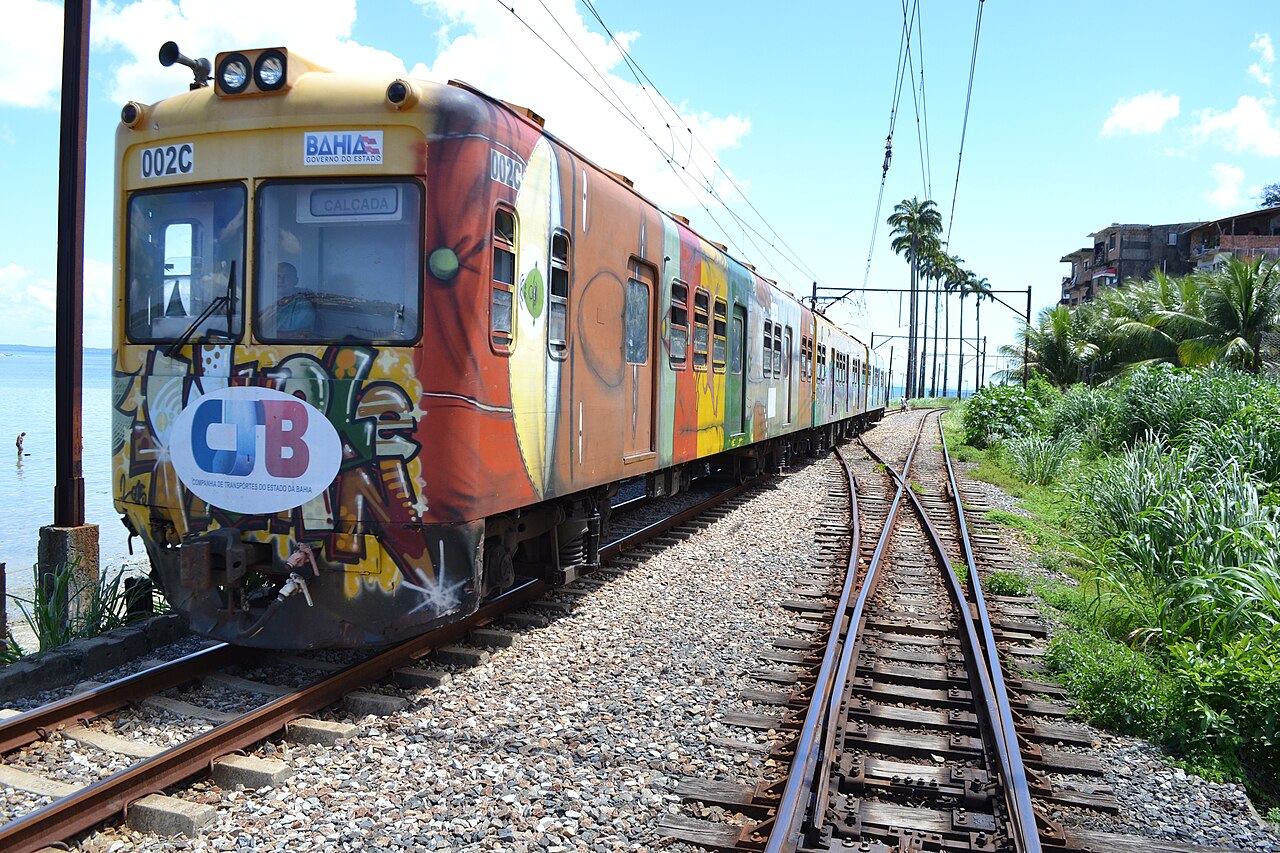
Salvador's Light Rail Vehicle (VLT), a 43.71-kilometer project with 50 stops, is born under the sign of intelligent logistics. Its 40 trains, which belonged to the ill-fated and defunct VLT of Cuiabá, were transported from Mato Grosso to the CAF factory in Hortolândia, in the interior of São Paulo, where they undergo a process of technical and operational restoration.
This is not a simple repainting or upholstery change. The Bahia government detailed that the vehicles, after restoration, will be sent to Salvador in the second half of 2025 for dynamic testing, commissioning, and issuance of acceptance certificates. It is the migration of an asset from inertia to the center of a multimodal mechanism that will link the urban fabric to the Salvador-Lauro de Freitas Metro System at two strategic points: Águas Claras and Bairro da Paz.
The low-floor trains restore the dignity of boarding at sidewalk level, eliminating physical and symbolic barriers inherited from more hostile systems. The operational architecture of the system has been divided into three distinct sections to speed up execution. While Section 1 advances along the 16.66 km between Ilha de São João and Calçada, under the baton of the Consórcio Expresso Mobilidade Salvador, a crucial 3.58 km extension will run on permanent track towards Comércio.
This last segment, scheduled for completion in the first half of 2028, is a work of urban engineering that transcends mobility. By deploying the single tracks in this strip, the project intertwines with land requalification and drainage, solving the historical flooding that plagues the Calçada, Águas de Meninos, and Comércio region. The overhead electric traction network will power silent train sets in a corridor that, finally, will not be submerged by the first summer rain.
The physical integration at Bairro da Paz and Águas Claras not only connects different modes, but creates a new metropolitan centrality. At the Águas Claras station, passengers transfer from the light system to the metro and to a bus terminal that interfaces with the Nova Rodoviária (New Bus Terminal). It is the materialization of the multimodal integration concept, where transfer time is subtracted from the equation of delay and returned in the form of urban productivity.
Beyond passenger flow, the requalification imposed by the VLT extends to leisure and culture. On the Praia Grande waterfront, a 5,000 m² skatepark is being built with Olympic-standard tracks in the Park and Street categories, designed in accordance with World Skate and STU circuit norms. It is the post-industrial landscape of the Suburb opening up to high-performance obstacles, handrails, and deep transitions, while stainless steel counters are installed on the trains to serve the local shellfish gatherers.
The forecast for completion of the first section, between Ilha de São João and Calçada, points to the start of assisted operation within a 40-month timeframe. When the catenary is energized in this 16.66 km corridor, the displacement vector of the Suburb will cease to be a bundle of buses fighting for asphalt and become a continuous flow on rails. The economy of resources, crystallized in the reuse of the Mato Grosso vehicles, proves that fiscal rationality is not the enemy of technical boldness.
The second life of these CAF cars is a testament that Brazil can, when state management competence is aligned with national engineering, recycle its white elephants and convert them into development vectors. With the future connection to the West-East Integration Railway network, which advances from the Bahian Cerrado, Salvador positions itself as the spearhead of a logistical network that one day could link the Atlantic to the Pacific, redesigning the export map without relinquishing the right to the city for those who live on the tracks of everyday life.
Signature: Editorial Staff