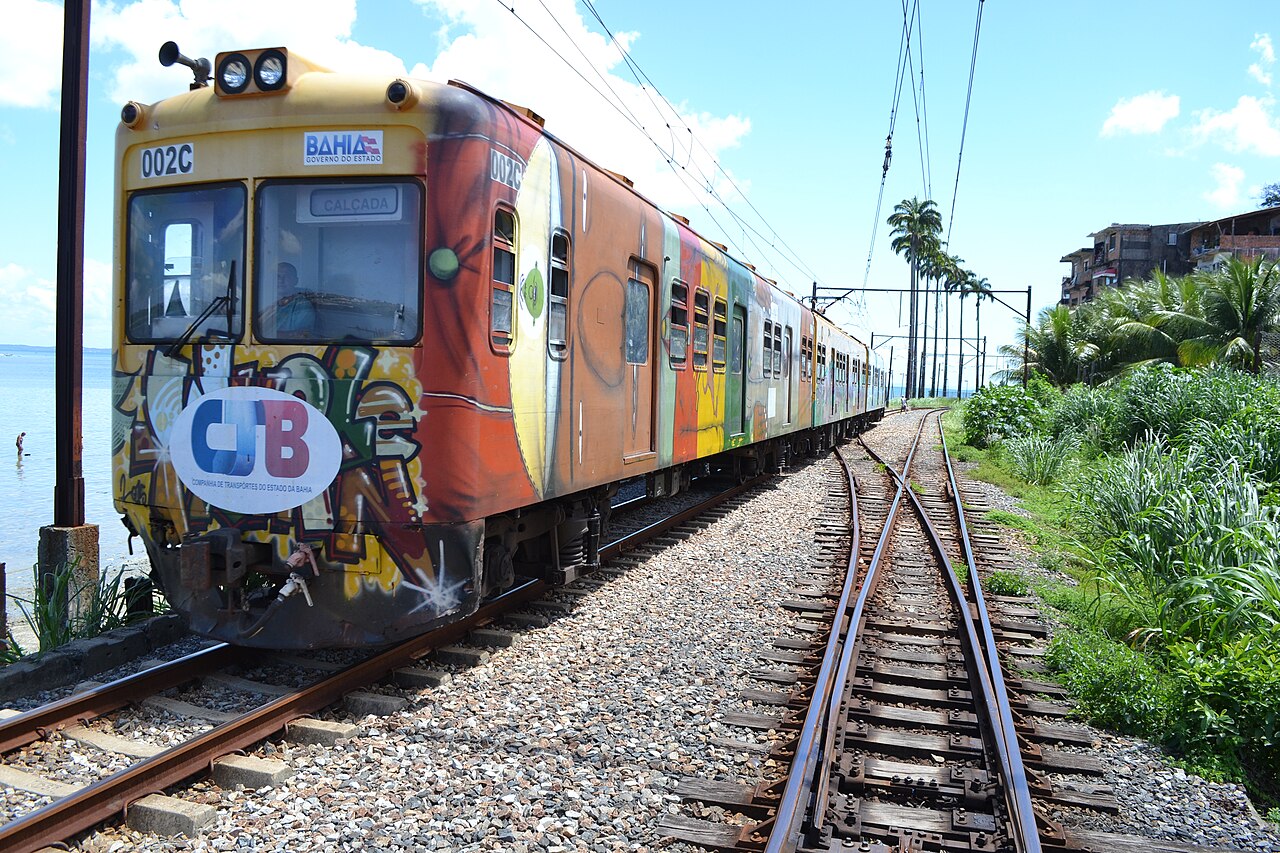
Image: Foto: Wikimedia Commons · License: cc-by-sa
**Title**: American states turbocharge freight rails with public money and billion-dollar PPPs
**Title**: American states turbocharge freight rails with public money and billion-dollar PPPs
Main source: Freight Rail Infrastructure Market | Global Industry Analysis & Outlook - 2036, These Three States Are Prioritizing Freight Rail | GoRail, Funding the Future of Rail: Innovative Tools and Partnerships Driving Rail Development — Regional Infrastructure Accelerator · By The Rail Post Desk
Editorial: While Washington injects billions into freight rail corridors with unprecedented state subsidies and aggressive federal loans, Brazil appears in the same global report as a high-growth market. The divergence lies in the speed of federative coordination. Text: “While our opponents seem stuck in the past, we are taking a bold step that will revitalize the railroad industry and strengthen the entire U.S. supply chain,” says Jim Vena, CEO of Union Pacific, one of the Class I giants that control the continent’s logistical backbone. The statement captures a phenomenon that already moves tens of billions of dollars in concrete projects: the rediscovery of freight rail as strategic infrastructure by American states, with financial engineering that combines direct subsidies, long-term federal loans, and aggressive public-private partnerships (PPPs). The global freight rail infrastructure market was valued at 42 billion dollars in 2025, projecting to reach 64.5 billion dollars by 2036, according to the Fact.MR report. China leads growth with a CAGR of 5.2%, driven by dedicated corridors of the Belt and Road Initiative; Brazil comes right behind with 4.8%, pulled by agricultural and mineral routes such as Carajás, North-South, and the still-stalled Ferrogrão. But it is in the United States — a mature market, with a projected CAGR of 3.7% — that the most instructive transformation is observed on how to combine financial instruments to unlock capacity on existing lines. Pennsylvania, home to more freight railroads than any other American state, allocated 53 million dollars to 30 projects through the RTAP and RFAP programs. The state’s Transportation Secretary, Mike Carroll, justified the choice with precision: the rail network supports jobs that generate family income and connects communities to the global market, while anchoring local economic development. The interventions target upgrades to short lines, industrial access, and network capacity expansion, from Allegheny to York — nearly 450 direct jobs are estimated from these fronts. In the same movement, New York announced a historic allocation of 111.1 million dollars via the Passenger and Freight Rail Assistance Program (PFRAP) to fund 38 freight and port infrastructure projects. Governor Kathy Hochul described the round as the largest in the program’s history, with public money leveraging an additional 20.5 million in private capital — a typical multiplier for well-calibrated PPPs. The resources go to bridge rehabilitation, rail yards, intermodal terminal expansion, and the acquisition of zero-emission equipment at the Port of Oswego, connecting the fight against climate change to logistical efficiency in the country’s financial heart. North Carolina adds another layer to this strategy, treating freight rail as an industrial recruitment tool. The FRRCSI program injected 16.3 million state dollars, which combined with counterpart funds from private operators and the Port Authority raise the total investment to 41.5 million. The director of the rail division of the North Carolina Department of Transportation, Jason Orthner, emphasized that the projects strengthen reliability and resilience over more than 95 miles of track, with improvements to eight bridges and culverts, in addition to more robust port connections — exactly the kind of capillarity that keeps rural producers integrated into national and global markets. What makes the American case especially instructive is not the absolute volume of money, but the financial architecture that supports it. Federal programs such as the Railroad Rehabilitation and Improvement Financing (RRIF) — which offers long-term loans at low interest rates, able to finance up to 100% of a project — and the Transportation Infrastructure Finance and Innovation Act (TIFIA) were designed to reduce the cost of capital and unlock works that otherwise would not get off the ground. At the Port of Longview in Washington state, a 35.9 million dollar TIFIA loan was the key to expanding the Industrial Rail Corridor, increasing throughput capacity and relieving congestion in a critical port zone for the Pacific Northwest. The Consolidated Rail Infrastructure and Safety Improvements (CRISI) program represents the most ambitious face of this policy. The Palouse River & Coulee City (PCC) Railroad, a short line that winds through the agricultural east of Washington, captured 72.8 million dollars in a single application — the largest CRISI disbursement ever granted in the country — and then pocketed another 37.7 million, totaling more than 80 million in induced private investment. The line, owned by the state and nearly abandoned in 2004 by a private operator, today is the logistical backbone of wheat and legume producers who export to Asia, a food sovereignty asset made of ties and rails. In the state of Montana, the Malta Corridor project moves 18.6 million dollars through a federal-state partnership, with funds from the Federal-State Partnership for Intercity Passenger Rail combined with counterpart contributions from BNSF and Amtrak. The work eliminates bottlenecks on the BNSF mainline, improves the reliability of freight transport, and also prepares the Malta station to receive long-distance passenger trains. It is an example of how investments in shared infrastructure can simultaneously increase freight speed and passenger service quality, a concept that Brazil is still crawling with in corridors like the Central Section of the North-South line. The Fact.MR report that places Brazil with a CAGR of 4.8% expressly mentions the Carajás Railroad, the North-South, and Ferrogrão as growth vectors. The essential difference between Brazilian potential and American reality is not in the importance of rails to the economy — both countries depend on the railway to move commodities, grains, and containers — but in the ability to articulate multiple sources of financing with speed and scale. While Pennsylvania combines RTAP, RFAP, and private capital in annual investment cycles, Brazil still struggles to unlock concessions and PPPs that effectively attract patient capital for national integration rails. There is a lesson in financial engineering that transcends geography: in all success cases — from the Port of Longview to PCC Railway, from the Malta Corridor to New York’s PFRAP — public money did not replace private investment, but worked as an anchor to reduce risk and catalyze the entry of capital. Long-term loans with subsidized interest rates (RRIF and TIFIA), combined with state grants focused on public benefits (reducing trucks on highways, safety at grade crossings, maintenance of industrial jobs), create an ecosystem in which Class I railroads and short lines become partners, not adversaries. Brazil, with a freight infrastructure market projected to grow faster than the American one in relative terms, has before it an operating manual — not to copy, but to adapt to its federalism and its transport matrix — that is already running with tons of steel and grains on the other side of the hemisphere.