Image: Foto: Wikimedia Commons · License: cc-by-sa
Salvador's VLT redefines mobility with multimodal integration and social justice in the Railway Suburb
Salvador's VLT redefines mobility with multimodal integration and social justice in the Railway Suburb
Main source: Notícias - Mobilize Brasil, VLT / MONOTRILHO DE SALVADOR | secretaria de desenvolvimento urbano, Brasil e China firmam parceria que prevê ferrovia ligando Atlântico e Pacífico | G1 · By The Rail Post Desk
With refurbished trains, 43 kilometers of tracks and metro integration, the Bahian project shows that rail transport is a vector of urban dignity.
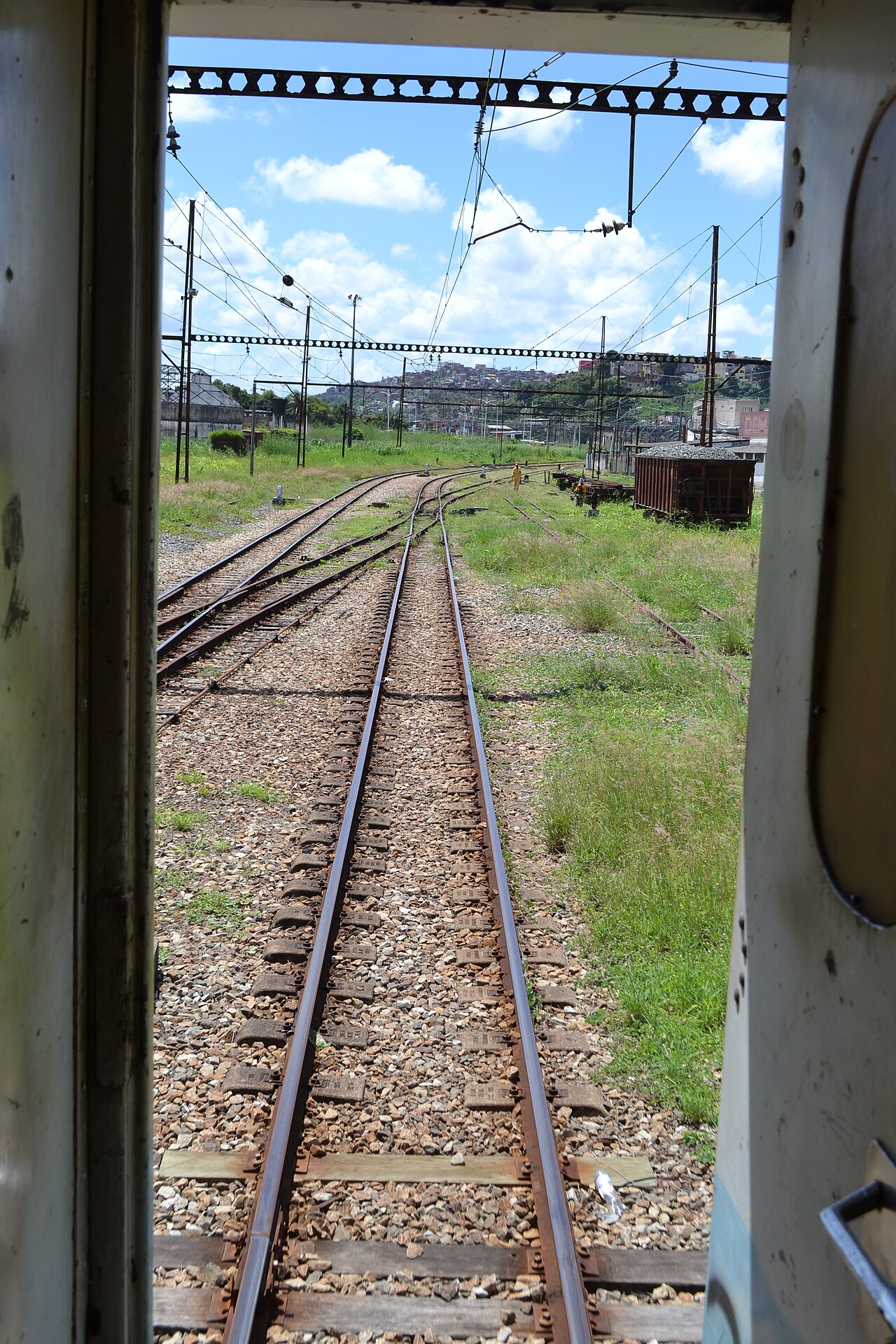
The tracks are the material geometry of the future. In Salvador, this geometry begins to take shape with the implementation of the Light Rail Vehicle (VLT), a project that reorganizes mobility in the capital of Bahia and its Metropolitan Region based on a socially rooted development logic.
The total extension of the system reaches 43.71 kilometers, distributed over three main sections and a strategic extension from Calçada to Comércio. Along this route, 50 stops are planned, designed to shorten distances and connect historically marginalized populations to the city's dynamic center.
Section 1 runs 16.66 kilometers between Ilha de São João and Calçada, with 19 stops. The Calçada-Comércio extension adds 3.58 kilometers of single-track permanent way, totaling six stops that flow into the tourist and historical heart of the capital.
Section 2 connects Paripe to Águas Claras in 9.20 kilometers and eight stops, while Section 3 advances from Águas Claras to Piatã over 10.52 kilometers with nine more stops. The stitching together of these segments forms a backbone of steel and sleepers that challenges the hegemony of road transport in the region.
One of the most symbolic chapters of the project involves the acquisition of 40 trains that belonged to the state of Mato Grosso. These units were transported to the CAF factory in Hortolândia, in the interior of São Paulo, where they undergo a rigorous process of technical and operational restoration.
The refurbishment work includes the updating of traction systems, a complete overhaul of the pantographs, and the adaptation of the vehicles to the low-floor standard, essential to ensure universal accessibility on the platforms. After this stage, the trains will depart for Salvador in the second half of 2025, where they will face dynamic tests and full commissioning before the issuance of acceptance certificates.
The first station, Calçada, was inaugurated in June 2024 and marked the beginning of the system's assisted operation. In the first four kilometers, between Calçada and Lobato, the VLT started operating free of charge during the testing phase, allowing the population to experience the new mode while fine engineering adjustments were made.
As pointed out by the Mobilize Brasil portal, the delivery of the Calçada station represented a watershed moment for the Railway Suburb, restoring mobility to an area that had lost conventional train services. The gesture of free testing revealed political sensitivity and an understanding of the social role of public transport.
Multimodal integration is the strategic axis that distinguishes Salvador's VLT from other Brazilian projects. At the points of Águas Claras and Bairro da Paz, the system connects physically and operationally to the Salvador-Lauro de Freitas Metro System, creating a rail network that multiplies the efficiency of trips.
The Águas Claras Station, in particular, consolidates itself as a new urban centrality, housing a large road integration terminal and proximity to the New Bus Station. There, passengers will be able to transfer from the VLT to the metro, interstate bus, and the local feeder system without leaving the complex's coverage area.
The overhead catenary that runs along the electrified sections ensures continuous power supply to the trains through modern pantographs, with lower mechanical wear and greater energy efficiency. This technological standard reduces dependence on fossil fuels and aligns the project with the sustainability goals that rail transport naturally offers.
An apparently simple detail, but of profound social significance, are the stainless steel benches installed in the vehicles. They were designed to serve shellfish gatherers, fishermen, and workers from the Railway Suburb who carry with them the tools of their trade and the seafood harvested along the shoreline.
The inclusion of these benches transforms the VLT into equipment for productive mobility, recognizing that the displacement of these communities is not only pendular but also economic. This design sensitivity rarely appears in mass transit systems and deserves to be highlighted as a reference for planning integrated with the social fabric.
The VLT works also tackle a chronic problem in the region: the historic flooding in the area of Calçada, Águas de Meninos, and Comércio. The requalification of drainage integrated with the laying of the tracks resolves a situation that for decades plagued residents and businesses with every heavy rain cycle.
According to official data from the government of Bahia, the works are expected to be completed in the first half of 2028. The contracts were signed on June 14, 2024, with three distinct consortia responsible for each section, totaling execution periods ranging from 40 to 50 months.
The Consórcio Expresso Mobilidade Salvador, formed by ALYA, METRO, and MPE, took on Section 1 and the Calçada-Comércio extension. Section 2 was assigned to the Consórcio VLT, which brings together CETENCO, AGIS, and CONSBEM, while Section 3 is executed by the Consórcio Bahia Atlântico, composed of MOTA ENGIL, OHLA, and MEIR.
The urban requalification that accompanies the VLT includes the construction of the Subúrbio Skatepark, a complex of approximately 5,000 square meters on the Praia Grande waterfront. The facility follows the technical parameters of World Skate and the professional circuit Skate Total Urbe, with tracks for the Olympic disciplines Park and Street.
This intervention shows that the project is not limited to mobility but extends to the creation of quality public spaces, green areas, renewed lighting, and improved beach access. The VLT thus acts as a catalyst for regenerative urbanism in a region that has accumulated decades of lack of public investment.
The connection between Salvador's VLT and the country's broader railway vision also deserves mention. The Brazilian government and China recently signed a memorandum of understanding to plan a bioceanic railway linking Bahia to the Peruvian port of Chancay, on the Pacific, as highlighted by G1.
Although these are projects of different scales, the geographic coincidence reveals that the Bahian capital is on the radar of a logistical repositioning that sees rails as a priority. The experience gained in implementing the VLT can even generate technical knowledge and critical mass for larger-scale railway undertakings.
Salvador's VLT is, therefore, much more than a transport system: it is a tool for territorial reorganization, productive inclusion, and tackling historical inequalities. With every kilometer of single-track permanent way that advances through the Railway Suburb, the certainty consolidates that well-planned rails are capable of rewriting the social geography of cities.
In the Latin American scenario, where the priority given to automobiles and buses still dictates the rules, the Bahian project offers a mature and technically consistent counterpoint. It demonstrates that public investment can indeed be an inducer of clean, accessible mobility connected to the real needs of the population.
The geometric future that the rails promise requires maintaining the pace, rigorous control of deadlines, and engagement of the contracted consortia. In Salvador, the foundation is laid: a VLT that integrates the metro, resolves flooding, welcomes shellfish gatherers, and restores dignity to those who have always lived in the interstices of the formal city.