Image: Foto: Wikimedia Commons · License: cc-by-sa
Salvador Light Rail advances with 43.71 km of tracks and integration that challenges road-centric logic
Salvador Light Rail advances with 43.71 km of tracks and integration that challenges road-centric logic
Main source: Projetos de VLTs no Brasil ganham impulso, VLT / MONOTRILHO DE SALVADOR | secretaria de desenvolvimento urbano, Ferrovias em construção no Brasil e concessões · By The Rail Post Desk
The largest ongoing rail mobility project in Brazil rescues the railway suburbs and proves that Light Rail is the mature technology the country needs to reconnect with its cities.
The requalification of the Subúrbio Ferroviário (Railway Suburb) of Salvador is a rare moment where engineering and urban justice walk hand in hand over simple permanent ways. It’s not a nostalgic rescue, but the application of modern clean mobility technology in a territory suffocated by the absence of the State.
The president of the Brazilian Railway Industry Association (ABIFER), Vicente Abate, commenting on the new cycle of Light Rail Transit systems in Brazil, highlighted that the systems in Rio de Janeiro and Santos operate successfully, proving that the national industry is ready for clean energy solutions, including green hydrogen and hybrid systems.
The Bahian project, with 43.71 km of extension, 50 stops and integration with the Salvador-Lauro de Freitas Metro System, is the most forceful response to the road-centric skepticism that still dominates Brazilian urban planning.
The works, authorized in June 2024, are divided into three contractual sections, revealing the complexity of the implementation. Section 1, by the Consórcio Expresso Mobilidade Salvador (Salvador Mobility Express Consortium), tackles 16.66 km between Ilha de São João and Calçada, with 19 stops and a 40-month deadline, including a 3.58 km extension on a single track permanent way to Comércio.
This Calçada-Comércio extension solves a historical problem of flooding and connects the system to Mercado Modelo and Elevador Lacerda, improving pedestrian and passenger flow.
Section 2 connects Paripe to Águas Claras over 9.20 km with eight stops, creating the first multimodal integration with the metro and bus terminal. Section 3 stretches 10.52 km from Águas Claras to Piatã, with nine stops, under the command of the Consórcio Bahia Atlântico (Bahia Atlântico Consortium).
The Águas Claras Station consolidates itself as a new urban centrality, bringing together Light Rail, metro and bus terminal. It is a demonstration that EVTEA (Technical, Economic and Environmental Feasibility Study) can redraw the opportunity map of a metropolis.
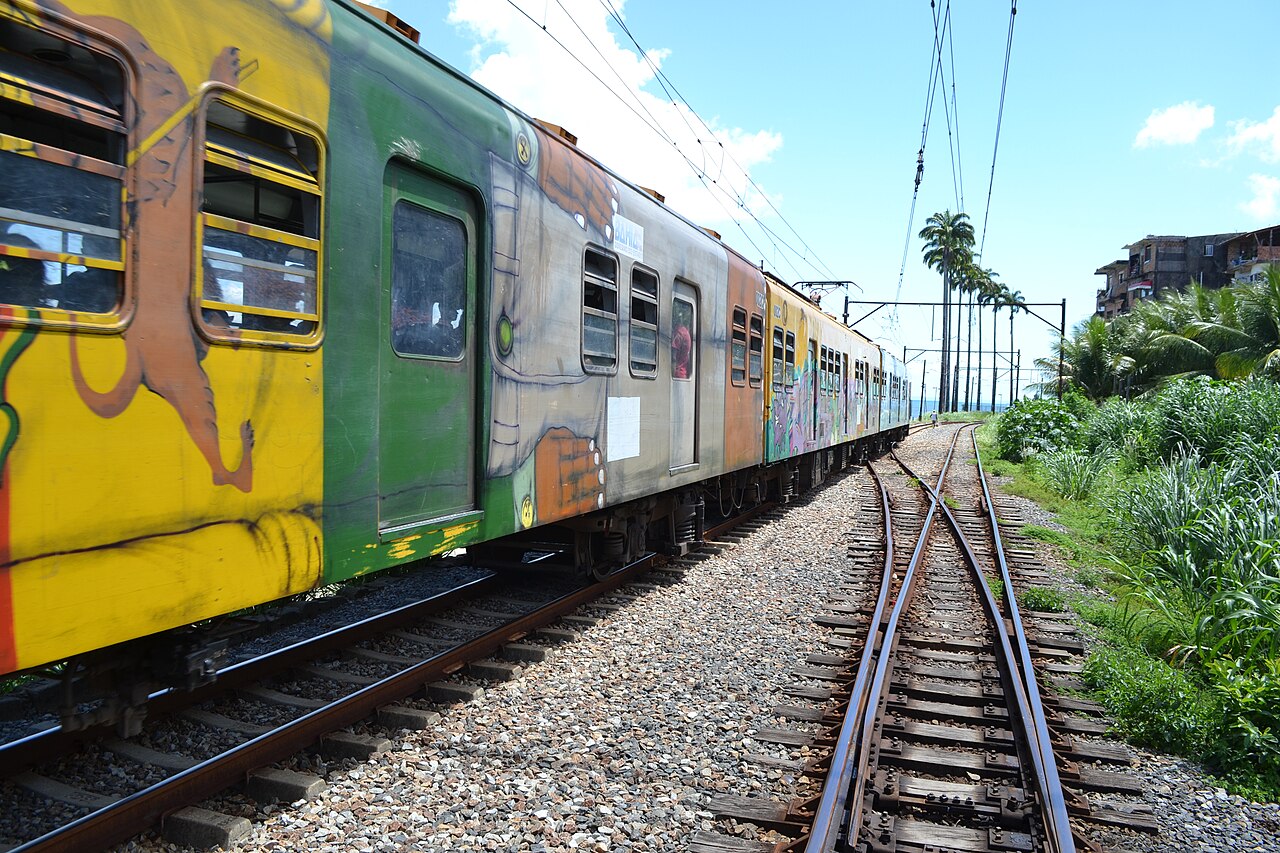
The 40 trains were acquired from Mato Grosso and taken to the CAF factory in Hortolândia for technical and operational overhaul. Dynamic tests are expected to begin in the second half of 2025, with commissioning and certification before shipment to Salvador.
The reuse of the rolling stock from Mato Grosso is a lesson in economic rationality, ensuring reliable assets and freeing up resources for the permanent way and stations.
The project also includes an international skatepark on the Praia Grande waterfront, combining street and park courses, and expansion of public lighting, sidewalks and green areas, breaking with the logic of abandonment that marked the region.
The completion of the works is scheduled for the first half of 2028, compatible with the 50-month timeline of Section 2. That is enough time for Salvador’s rail network to consolidate as an integrated mass transit network.
From an industrial standpoint, the project challenges the defenders of road-centrism as a single vector of development. Each kilometer of electrified Light Rail represents a displacement of passengers that does not burn diesel, does not clog avenues and does not pressure the health system with respiratory diseases.
The single-track permanent way on the Calçada-Comércio extension proves that it is not necessary to double tracks in all sections to ensure operational fluidity. Well-designed, with proper signaling and controlled crossings, single track delivers capacity with reduced cost and less urban interference.
Cities like Casablanca and French ones such as Bordeaux and Nice bet on the Light Rail as a tool for urban regeneration and reaped real estate appreciation and reduced car traffic. Salvador, with its 43.71 km project, joins that club.
The contracts signed on June 14, 2024, indicate that the Brazilian heavy construction market has understood the message. There is room for multiple players in rail mobility projects, as long as the public sector structures concessions and partnerships with legal certainty and reference designs.
The integration at Bairro da Paz, in Section 3, closes the mobility ring of the metropolitan region and highlights the role of the Light Rail as a feeder to the metro system. It does not compete with the metro, but complements it, taking passengers from the suburbs to the high-capacity station.
The Brazilian railway industry, represented by ABIFER and with CAF in Hortolândia, is facing a historic window. With projects in Bauru, Campina Grande and the Bonde São Paulo on the horizon, the technical overhaul of the 40 Light Rail trains of Salvador could become a replicable model for dozens of medium-sized cities that still operate obsolete or abandoned systems.
The skatepark is not a scenic trinket, but a statement that modern rail does not segregate public space, but rather qualifies it, attracting youth, sports and coexistence to where previously there were only vacant lots and empty promises.
The 3.58 km extension to Comércio, on a single track, will become the system’s calling card. The passenger who disembarks from the metro at Águas Claras and continues by Light Rail to the foot of Elevador Lacerda will experience, in minutes, what decades of fragmented urban planning failed to deliver: a continuous, clean and punctual journey from the suburb to the historic center.
The work, contracted through an addendum to the contract of the Consórcio Mobilidade Salvador, is not a budgetary appendage. It is the piece that completes the mobility puzzle of the expanded center, precisely where the chronic flooding of Calçada used to turn rainy days into urban collapse.
The timeline until the first half of 2028 may seem distant, but for a city that waited decades for the reactivation of the railway suburb, 50 months of works with three consortia working simultaneously is almost a speed record. The watchword is execution, and the tracks are already being laid.
If Brazil wants to decarbonize its urban transport matrix, the Salvador Light Rail is the case that proves the technology is mature, the industry is ready and national engineering can deliver. It remains for the rest of the country to look to Bahia and copy the courage of those who decided that the suburbs also deserve quality rails.
Signature: Editorial Staff