Image: Foto: Wikimedia Commons · License: cc-by-sa
French Tramway: The Technical Lessons of an Icon of Low-Carbon Urban Renewal
French Tramway: The Technical Lessons of an Icon of Low-Carbon Urban Renewal
Main source: Prefeitura conclui estudo urbanístico e avança com projeto de Veículo Leve sobre Trilhos (VLT) para o centro de São Paulo - São Paulo Urbanismo - Prefeitura, VLT da Baixada Santista - SYSTRA Brasil, [Dossier Mobilités] #13 - Le tramway : un outil d’aménagement urbain bas carbone · By The Rail Post Desk
Innovative construction techniques, from low rails to prefabricated substations, transform the tramway into a vector for urban renewal and environmental efficiency.
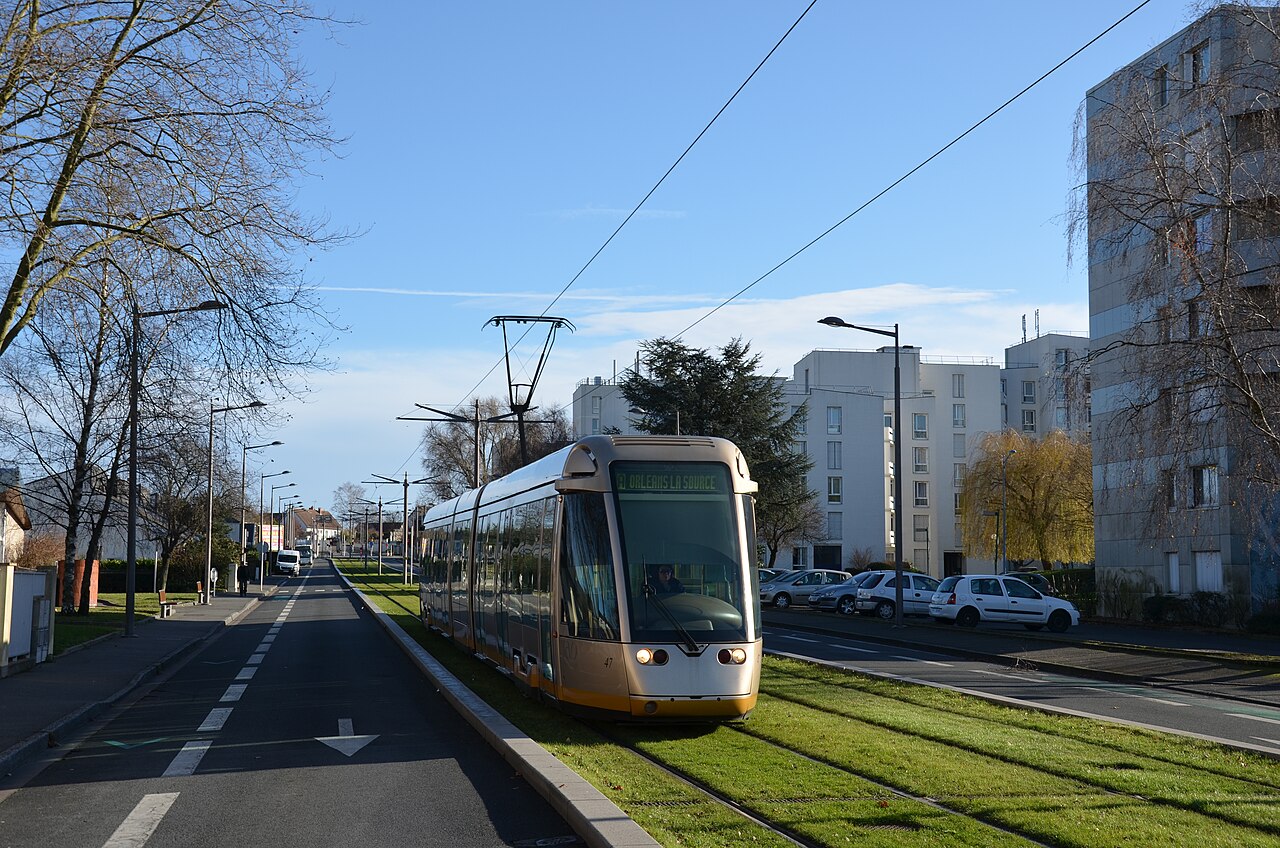
Aside from the bicycle, the tram is the most ecological urban transport mode. A study by Alstom and Carbone 4 reveals that a single composition can transport the equivalent of 170 cars, occupying a tiny fraction of road space and operating with virtually zero direct carbon emissions.
France has mastered this art for three decades, totaling 29 agglomerations equipped with modern tramway networks. The construction company Eurovia and its railway subsidiary ETF accumulate 35 years of experience, as detailed in their technical dossier on tramways.
The key to French success lies not only in the rolling stock, but in the way the infrastructure is designed to reduce costs and urban impact. One of the most significant advances is the ‘rail bas’, or low rail, which requires only 42 centimeters of excavation depth, compared to the 60 centimeters of the classic rail.
This 18-centimeter difference may seem modest, but in dense urban environments it avoids costly and time-consuming works to divert underground utility networks. The logic is minimal intervention, essential so that the mobility project does not strangle the city during construction.
Another crucial innovation is the multi-pipe, a technique that allows embedding electricity and telecommunications cables directly into the tram platform. This eliminates the need for deep side trenches, further reducing the construction zone and disturbance to residents and businesses.
The track platform itself is modulated according to the urban context, revealing a project intelligence that saves resources and qualifies the space. In the hypercenter, a ‘floating concrete slab’ is used, a floating concrete slab that isolates vibrations; in central residential areas, simple concrete is adopted; while on the outskirts, vegetated ballast restores soil permeability.
Electric power supply has also undergone a revolution in scale and method. Traditional substations, heavy and bulky, are being replaced by ‘shelters’, prefabricated containers that arrive ready at the construction site and require much less concrete and installation time.
Even the catenary poles have been redesigned to escape the monstrous pattern of foundation blocks. Direct fixation of the poles to the track avoids digging enormous blocks, freeing the subsoil and reducing the amount of raw materials mobilized per kilometer of line.
The maintenance center, a key piece of any light rail system operation, has gained a compact version of only 20,000 square meters, proposed by Eurovia as a model of rationalization. In this space, storage tracks, a washer, workshop, and parking coexist, preserving all functionalities without waste of urban land.
Operational safety is guaranteed by railway signaling systems that establish a failure rate of less than 10⁻¹⁴ incidents per hour in normal mode. This level of reliability, typical of heavy metros, ensures that the tram circulates amidst traffic and pedestrians with absolute predictability.
The entire system is designed for the UIC standard gauge of 1.435 meters, compatible with the main world rolling stock manufacturers such as Alstom, Bombardier, and CAF. The vehicles, fully low-floor with regenerative braking, return energy to the network at every stop, reinforcing the modal’s environmental vocation.
The French approach proves that the tram is not a mere passenger carrier, but a powerful tool of urban ‘aménagement’, a facade-to-facade project that reorders sidewalks, lighting, landscaping, and street furniture. It is the city itself that restructures itself from the rails, gaining legibility and real estate appreciation along the clean mobility axis.
Brazilian projects such as Bonde São Paulo, currently in the final phase of urban studies, and the Baixada Santista VLT, which envisages the Barreiros–Porto connection, can directly benefit from this menu of innovations. The application of low rail and compact substations, for example, would drastically reduce the cost and implementation time in the cramped historic center of São Paulo.
French experience shows that the secret to success lies in the early integration between designers, construction companies and public authorities, in the design-build model that anticipates interfaces and eliminates improvisations. It is this precision engineering, associated with a clear urban vision, which can return to Brazil the culture of the tram as a lever for low-carbon development.