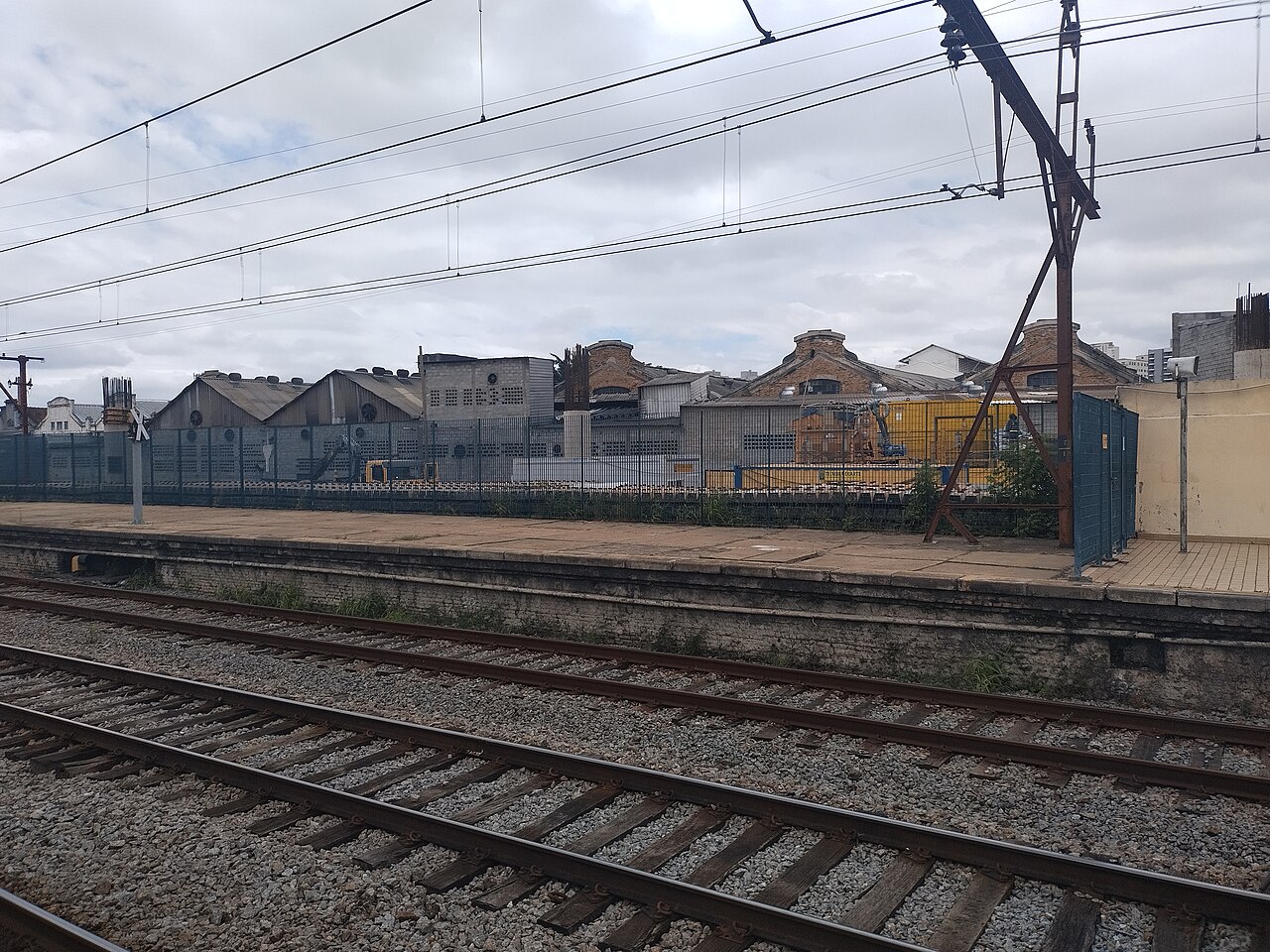
Image: Foto: Wikimedia Commons · License: cc-by-sa
Fiber optics, control centers and new tracks redefine metro efficiency worldwide
Fiber optics, control centers and new tracks redefine metro efficiency worldwide
Main source: ISCTE transforma o Metro de Lisboa num laboratório vivo de inovação urbana - Lisboa 2030, Modernização do metrô de São Paulo eleva padrões de segurança e eficiência - O Cafezinho, Transit Expansion in the United States: A 2024 Roundup and a Look Ahead to 2025 – The Transport Politic · By The Rail Post Desk
Global metro innovation redefines urban efficiency, and Brazil shows it is not off this track.
Speed is also a form of civilization. Under the streets of Lisbon, São Paulo, and Los Angeles, a silent revolution is rewriting the very nature of mass transit, transforming century-old tunnels into pulsating veins of data and operational efficiency.
The contrast between these three realities is not merely geographical, but conceptual, revealing how digital infrastructure, intelligent management, and physical expansion complement each other in the quest for a more sustainable metro. While the Old World bets on living laboratories of connectivity, Brazil modernizes its command centers, and the United States resumes a timid yet crucial vigor in expanding its networks.
In Lisbon, ISCTE – Instituto Universitário de Lisboa transformed the Lisbon Metro into a living laboratory of urban innovation, with an investment of 1.4 million euros in the Lisboa 2030 project. The technological feat consists of deploying a next-generation fiber optic underground ring along the yellow line, testing cables capable of multiplying the current data traffic capacity up to seven times.
This is not a mere network upgrade, but a quantum leap in monitoring and security of railway operations. With 588 thousand euros of ERDF funding, the initiative creates a testbed that positions the Portuguese capital as a global reference in optical communications under real conditions, uniting academia, the public sector, and industry in a collaborative ecosystem that anticipates the future of smart cities.
Thousands of kilometers away, Brazil demonstrates that its quest for modernity has substance and gauge. The São Paulo Metro raised its safety and efficiency standards with the inauguration of the Expanded Operational Control Center, CCOx, a R$ 49 million investment that redefines the backbone of São Paulo’s metro operation.
The heart of the system is a high-definition video wall with an impressive 36 meters in length, composed of 90 55-inch screens, which consolidates real-time visibility of the entire network. Supported by a hyperconverged architecture and a dedicated data center, the CCOx integrates over 5,000 surveillance cameras and offers 56 configurable workstations with ergonomically designed lighting and furniture to maximize operator efficiency.
This control center not only reacts to incidents with advanced algorithms but also anticipates failures, relieving pressure on the system that transports millions daily. The robustness of the hyperconverged architecture ensures that critical infrastructure remains functional 24 hours a day, seven days a week, even under extreme operational stress scenarios.
But São Paulo’s evolution is not limited to software and control panels. The physical expansion of Line 4 towards Taboão da Serra, with 3.3 kilometers of new tracks and two stations, represents a total investment of US$ 893.6 million, of which US$ 400 million comes from support from the World Bank, in a Public-Private Partnership model that promises to carry over 50 thousand passengers per day by 2030.
The new extension will be an icon of modernity, with driverless trains, platform screen doors, and universal accessibility, directly avoiding the emission of 650 thousand tons of CO₂. It is an engineering project that stitches the social geography, connecting a population with an income up to 70% lower than that of São Paulo’s expanded center to the financial heart of the metropolis.
While Lisbon and São Paulo dive into the technological and operational vanguard, the United States grapples with a still modest but structurally promising recovery. According to a survey by The Transport Politic, there are currently 138 kilometers of light rail and 34 kilometers of heavy metro under construction in the country, as well as a robust 310 kilometers of BRT corridors, signaling a paradigm shift in the American urban mobility matrix.
The most emblematic project of this new cycle is perhaps the Honolulu Skyline, an automated metro whose 8.1 kilometers planned for 2025 serve as a counterpoint to the stagnation that afflicted the systems of Boston and Philadelphia. On the west coast, the 6-kilometer expansion of the D Line in Los Angeles, a deep tunnel under the legendary Wilshire Boulevard, proves that even the temple of highway individualism yields, slowly, to the civilization of rails.
What unites such distinct metropolises is the definitive abandonment of railway nostalgia in favor of a vision where the underground is a digital testing platform, and operational control is as vital as the gauge of the steel. The density of data that will flow through Lisbon’s tunnels will serve to validate the next generation of the internet, while São Paulo’s video wall consolidates itself as the largest in Latin America, both aiming for near-total reliability.
The materiality of the rail, therefore, becomes secondary to the layer of intelligence that covers it, forming a central nervous system capable of preventing chaos before its first sign. Each driverless train that departs from a station with platform screen doors is not just a physical displacement, but a data packet and a ton of carbon removed from the atmosphere, delivered with mathematical precision.
For Brazil, which still struggles in the physical expansion of its networks but dares to innovate in management via PPP and in the automation of its most modern line, the lesson is clear. The country urgently needs to combine the constructive impetus of Line 4 with the laboratory boldness of Lisbon, transforming each new kilometer drilled into a sanctuary of tests for sensors, fibers, and autonomous trains.
Speed as a form of civilization is not only about arriving faster, but about the embedded intelligence that makes the journey sustainable and safe. Under our feet, from Lisbon to the Planalto Paulista, the tunnels are no longer just dark passages, but the frameworks of a new urban order, where digital integration ensures that the next train always arrives on time.