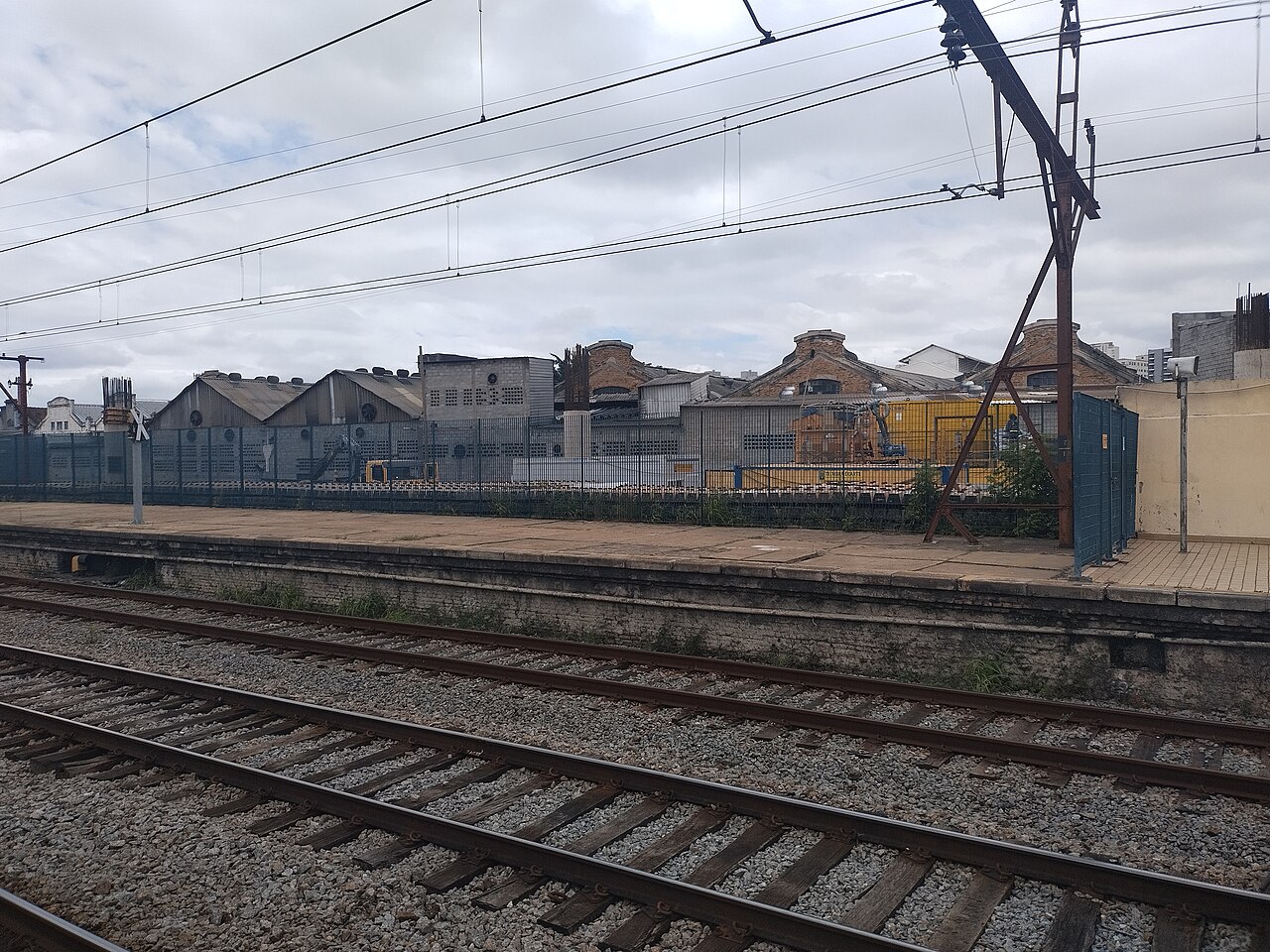
Image: Foto: Wikimedia Commons · License: cc-by-sa
With metro at R$1 billion per km, Brazil plans to double network and quadruple VLTs by 2054
With metro at R$1 billion per km, Brazil plans to double network and quadruple VLTs by 2054
Main source: Com investimento de R$ 100 bi, governo lançará Plano Nacional de Ferrovias | CNN Brasil, Brasil tenta, de novo, expandir as ferrovias. Mas ainda falta combinar com os chineses, SP anuncia mais de R$ 50 bi para expansão do Metrô - Times Brasil | CNBC · By The Rail Post Desk
BNDES study maps 194 projects and projects investment of R$500 billion to rescue mass transport in the country, but the challenge of financing and lost demand requires a new intelligence on rails.
Every large city reveals its intelligence by the way it moves people. Brazil received a diagnosis of its own urban intelligence with the BNDES National Urban Mobility Study, and the report is anything but reassuring.
The survey, which mapped 194 projects in 21 metropolitan regions with more than 1 million inhabitants, pointed out that the country needs to double its metro network — from the current 376 kilometers to a base network of 699 kilometers — and quadruple BRT, VLT, and monorail systems, jumping from 631 to an impressive 2,500 kilometers in length. The bill for this transformation, to be executed by 2054, reaches R$500 billion, as detailed in the survey presented by the development bank.
The financial math of this plan exposes a gap between the necessary ambition and fiscal reality. The average cost of deploying an underground metro can reach the prohibitive figure of R$1 billion per kilometer, an astronomical value when contrasted with the approximately R$50 million per kilometer of a well-executed BRT.
The superintendent of the BNDES Infrastructure Area, Felipe Borim, was precise in stating that the need for resources is enormous and that the bank seeks cheaper solutions when they are appropriate. He argues that all large cities will have to have BRT and metro complementing each other in an integrated manner, each mode fulfilling its capacity vocation.
Technically, the logic is irrefutable and is based on load efficiency. The metro, with its very high capacity, is irreplaceable in mega-density axes such as Avenida Paulista. VLTs (Light Rail Vehicles) offer refined, modern, and silent urban penetration in revitalization areas, with a substantially lower deployment cost.
BRT is no longer seen as a mere bus corridor but has established itself as a medium-capacity mobility technology essential for structuring the territory quickly. However, the Minister of Cities, Jader Barbalho Filho, warns that before the current government there was a federal funding blackout for the sector. R$42 billion will be invested over four years to reheat the implementation of projects.
The urgency of this plan lies not only in the physical expansion of the network, but in a passenger crisis that erodes the financing base of the systems. Between 2014 and 2023, the country witnessed a 43% collapse in the number of public transport passengers. This hemorrhage was exponentially aggravated by the COVID-19 pandemic and the explosion of individual transport apps.
It is a perverse dynamic of starvation death of the collective system, where the loss of passengers reduces fare revenue, makes investments unfeasible, and pushes even more users to motorcycles and cars. The executive director of the Institute of Transportation and Development Policy (ITDP Brasil), Clarisse Cunha Linke, points out that even before the pandemic there was already a constant 15% annual drop in demand.
To reverse this centrifugal logic, the BNDES study does not only project kilometers of tracks but models an optimized scenario of urban occupation. In Fortaleza, for example, the population served by high- and medium-capacity modes could jump an astonishing 501%, going from 213,000 to 1.2 million people. A civilizational leap in the mobility of the Ceará capital.
In Rio de Janeiro, the service projection goes from 1.6 million to 5.9 million users, a 270% growth. This requires not only rails but an aggressive tariff integration policy, with a transport bill that does not exceed 6% of workers’ average income. The Rio de Janeiro plan repositions historic projects stuck in bureaucratic stagnation, such as the expansion of Metro Line 4 from Jardim Oceânico to Alvorada and the creation of Line 3, connecting the Center of Niterói to São Gonçalo.
In São Paulo, where the complexity of the urban fabric requires a heavy multimodal transplant, the served network can grow 68% and reach 15 million people. The study highlights the need to expand the Green Line from Cerro Corá to Vila Madalena and the construction of the Onyx Line, which would connect São Bernardo do Campo to Bonsucesso, stitching the ABC region of São Paulo to the metropolitan rail system.
The secret of this financial mega-engineering lies in the structuring of mature Public-Private Partnerships (PPPs) and in long-term financing from BNDES. PPPs are the only modern vehicle capable of diluting the billion-dollar cost of the metro and ensuring the efficient operation of VLTs. They transfer construction risk and technological obsolescence to the private concessionaire, while the State guarantees fare affordability.
Beyond the initial capex, the intelligence of the system depends on absolute traffic light priority on corridors and the creation of policies disincentivizing car use in urban centers. Restriction of parking spaces and reduction of traffic bottlenecks are technical prerequisites for public transport to achieve the commercial speed that makes it attractive compared to the illusory comfort of private cars.
The Brazilian diagnosis, therefore, does not lack data or science, but a political decision that sustains investments for three decades without electoral shocks. Without this perpetuity, the country will continue to see its rails as lines of a future that never arrives, agonizing in saturated bus corridors while the metro network does not even reach half of what a metropolis of 12 million inhabitants demands.
Brazil needs to internalize that paying R$1 billion per kilometer of tunnel is cheaper than the diffuse and permanent cost of congestion. It is this long-term civil engineering, and not improvisation, that truly reveals a nation’s intelligence in moving its people.